Section pages
Find your research path
A question.
A method. A test.
Follow the idea from its rationale to a concrete design choice and the evidence needed to evaluate it. Choose the question closest to your work.
Path 01 / 04
What must survive when documents become context for an AI system?
Research papers describe design intent. Evaluation protocols identify what still needs to be demonstrated.
CATEGORY
TAG
ALL · 23
newest first
What it takes to check an AI-assisted assessment
A citation is a starting point. Useful review also needs the source version, the inference being made, the missing evidence, and a record of what a person actually checked.
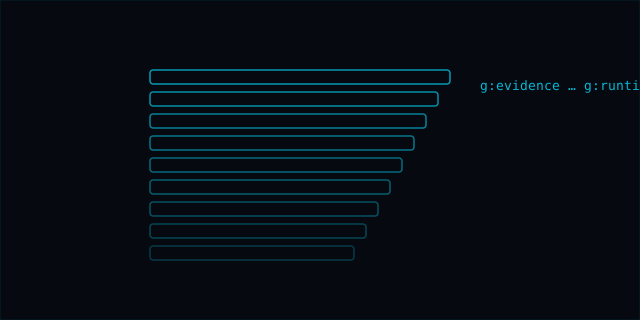
Nine layers, one capsule: separating evidence from interpretation
The layer model is a proposed division of responsibilities. Its value depends on whether readers and software can preserve those distinctions through updates, queries, and export.
Capturing expert methods without claiming to capture the expert
A useful method needs examples, limits, and a way to tell when it does not apply. Structured interviews can help uncover that material, but a transcript is not a transferable skill.
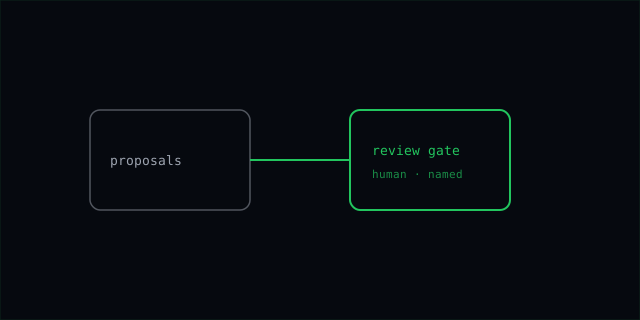
The proposal boundary: separating a model’s suggestion from accepted context
Review is a state transition with evidence, permissions, and concurrency rules. A button labeled Approve is only one part of the implementation.

A capsule registry starts with versioning, rights, and withdrawal
Before distributing reusable knowledge, we need to say which artifact a person received, what they may do with it, and how they learn that it has changed.
Why TACITUS: keeping the context behind an analytical judgment
The question is whether structured, reviewable context can make difficult analytical work easier to continue, challenge, and hand over. The architecture is a hypothesis we need to test.
AGON: extracting a claim without endorsing it
Conflict analysis starts with careful attribution. This research note describes how candidate actors, claims, and commitments could reach a reviewer without acquiring authority along the way.
KAIROS: keeping an uncertain timeline honest
An event date, a publication date, and the date an analyst receives a report answer different questions. Temporal analysis needs to preserve all three.
A record that helps a mediator ask better questions
A mediation record should preserve qualifications, disagreements, and permissions. It should help a practitioner prepare without pretending to settle the dispute.
From seven graphs to nine capsule layers: separating records by responsibility
The useful question is what each part of a knowledge object means, how it can change, and which other artifacts depend on it. Counting graphs is a consequence of those decisions.
A policy brief should show what could change the decision
Useful policy analysis makes the objective, alternatives, constraints, and uncertain assumptions inspectable. A fluent recommendation is only one part of that work.
Following a claim through the information environment
Defensive narrative analysis depends on source relationships, timing, and uncertainty. Counting mentions is not the same as corroborating a claim.
Decomposing an analytical task: model proposals, explicit checks, human decisions
A useful agent workflow needs more than a sequence of prompts. Its intermediate records must let us locate an error, repeat a check, and decide what may become shared knowledge.
Two clocks for an assessment: what applied, and what was recorded
A corrected date should improve today’s analysis without rewriting what a reviewer could have known last week. Bitemporal records make those two questions explicit.
A durable knowledge layer for a finite context window
PRAXIS is the workspace. Context Capsules are the reusable records we want people and agents to work from. The engineering problem is selecting enough evidence for a question without confusing a compact view with the complete case.
What an analyst should inherit: sources, decisions, and unresolved questions
A handover is a versioned dependency problem. The next person needs to know which records the assessment relied on, which decisions they may reuse, and what has changed since those decisions were made.
A stable vocabulary with reviewed domain extensions
A commitment in a regulatory consultation and a commitment in a ceasefire agreement share useful structure. Their conditions, evidence, and consequences can still differ. An ontology needs room for both facts.
Keep the disagreement in the record
A useful knowledge system should let an analyst challenge an inference without losing the evidence that produced it. That requires decisions about identity, scope, versioning, and retrieval—not just a dispute flag.
What “under development” should let you verify
A development label is useful only when it points to a concrete boundary: what a version does, where the evidence comes from, and which claims remain untested.
Where language-model analysis needs external structure
Complex questions can fail at retrieval, interpretation, or review. The engineering task is to identify the failure and choose the smallest useful intervention—not declare that a model cannot reason.
A stated position is evidence. An inferred interest is a hypothesis.
A graph can help an analyst compare explanations for a demand, provided it never hides who proposed an explanation or how it could be wrong.
A statement of intent is not yet a commitment
To answer what someone owes, promised, or completed, a system needs more than future-tense sentences. It needs the actor, action, conditions, authority, evidence, and an explicit record of interpretation.
A schema checks the record. An ontology explains the terms.
Structured knowledge helps an AI system only when its fields have useful meanings and those meanings survive retrieval, revision, and exchange. A valid JSON object is one part of that contract.
STAY IN THE LOOP
Follow the research as it develops.
Subscribe via RSS or JSON Feed. We also welcome corrections, questions, and examples that challenge the approach.