TL;DR
- 01A source passage, an extracted claim, and an approval are different records, even when they concern the same sentence.
- 02The nine layers describe logical responsibilities; they do not require nine databases or establish the truth of their contents.
- 03Schema validity, source traceability, and semantic correctness need separate checks.
The layer model is a proposed division of responsibilities. Its value depends on whether readers and software can preserve those distinctions through updates, queries, and export.
Revision: Expanded the layer model with a worked claim, cross-layer invariants, serialization tradeoffs, and concrete validation requirements. Added the scoped responsibilities are not a count of delivered services example and its evidence boundary.
Follow one statement through the object
Suppose a fictional municipality publishes a notice saying that bridge repairs are expected to finish in October. An analyst later records that the timetable depends on a permit. A model proposes “the bridge will reopen in October.” All three statements concern the same project, but they have different authors, evidence, and status. Storing them under one completion-date field would discard the distinction the reviewer needs most.
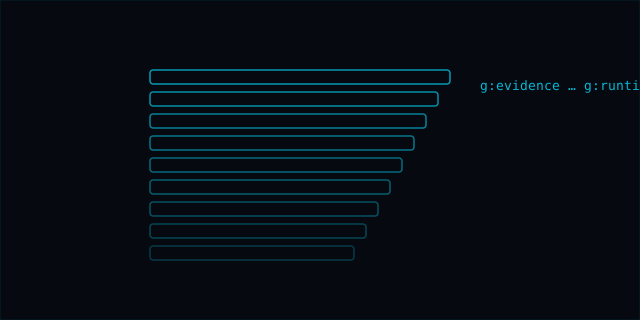
Our proposed Context Capsule model separates these responsibilities into nine layers. The captured notice belongs to evidence. The extracted expectation belongs to claims. A relation connecting the repair to the bridge belongs to the situation record. The expected interval belongs to temporal information. The reviewer’s qualification belongs to governance. These references should point to the same underlying records rather than copying slightly different versions into each layer.
| Layer | What it contains | Boundary to preserve |
|---|---|---|
| Evidence | Sources, passages, rights metadata | A captured statement is not automatically a fact |
| Claims | Attributed assertions and disputed status | Extraction and acceptance are separate |
| Situation | Entities and relevant relationships | An inferred relationship needs its own support |
| Temporal | Event intervals, reporting dates, uncertainty | Expected time differs from observed time |
| Ontology | Definitions and versioned extensions | Changing a definition can change a query |
| Reasoning | Methods, hypotheses, interpretation | An explanation differs from its evidence |
| Memory | Build and revision history | A prior output is not an independent source |
| Governance | Decisions, qualifications, permissions | Approval has a scope and a version |
| Runtime | Consumer instructions and constraints | Instructions need implementation and testing |
A representation does not supply the semantics
JSON-LD 1.1 supports linked data and named graphs, which makes it a candidate representation for related records. It does not prescribe these nine layers or define what TACITUS means by “accepted.” Those are application semantics we must document and test. A consumer that parses the JSON successfully might still mistake an expected date for an actual completion date. [1]
PROV offers another useful distinction: the notice and extracted claim are entities, extraction and review are activities, and the publisher and reviewer are responsible agents. A provenance bundle can itself have provenance. That helps us describe how a capsule was assembled without pretending its contents were all produced by one trustworthy process. [2]
{
  "claim": {
    "id": "claim-17",
    "text": "Repairs are expected to finish in October",
    "source": "notice-4#passage-2",
    "temporalRecord": "interval-8"
  },
  "review": {
    "target": "claim-17",
    "sourceVersion": "notice-4-v1",
    "decision": "accept_with_qualification",
    "qualification": "Forecast, conditional on permit approval"
  }
}
Define the joins before adding more layers
The design needs invariants across records. An accepted claim must resolve to the reviewed source version or explicitly declare that it is an inference. A revision must not silently inherit a decision made on different text. Deleting a source under a retention rule must leave an intelligible missing-source state in dependent records. A query should specify whether it includes proposed, accepted, rejected, or superseded material.
Passage references deserve particular care. W3C’s annotation model describes both text quotations and character-position selectors. A selector is meaningful relative to its target representation; re-extracting a PDF can change offsets even when a human sees the same page. A capsule therefore needs to identify what representation was selected, not merely which URL was visited. [3]
Repeatable serialization is a separate concern. RFC 8785 defines a JSON canonicalization scheme useful when cryptographic operations need consistent bytes. It does not make semantically equivalent JSON-LD documents equivalent, validate an ontology, or prove a claim. We should state exactly which representation a digest covers instead of describing an object as simply “verified.” [4]
Where the complexity must earn its place
Nine responsibilities can become nine opportunities for inconsistency. An early implementation may keep them in a small number of files or tables with explicit references. An embedded graph can be a derived query projection; it should not become a second competing account of accepted state. Importers need a declared compatibility policy when an ontology version or required runtime rule is unknown.
For DIALECTICA development, a useful test fixture starts with the bridge notice, qualifies the forecast, supersedes it with a new date, and exports the capsule. A second consumer should reconstruct what was known at each revision, preserve the qualification, and reject dangling references. PRAXIS should display those distinctions in ordinary review work. Until those tests pass across supported consumers, the layer diagram is an architectural proposal, not evidence of interoperability.
Responsibilities are not a count of delivered services
A reviewed output can still be unsupported. Keep author assertion, source access, rights and exact-revision local acceptance separate. [5]
| Concept | Current meaning |
|---|---|
| Four contextual roles | User / Situation / Tool / Output: purpose, never executable permission |
| Seven communication lenses | Alternative views of the same authored records |
| Nine responsibilities | Evidence / Claims / Situation / Temporal / Ontology / Reasoning / Memory / Governance / Runtime |
| Eight-layer compiled fixture | The historical minimal reference has no separate memory layer; this is a crosswalk, not a schema migration |
SOURCES
- [1]W3C (2020). JSON-LD 1.1.Defines linked data serialization and named graphs; it does not define the proposed nine-layer model or review semantics.
- [2]W3C (2013). PROV-DM: The PROV Data Model.Defines provenance entities, activities, agents, and derivation; it does not establish truth, authorization, or TACITUS conformance.
- [3]W3C (2017). Web Annotation Data Model.Defines source selectors and their limitations; used for locator design, not a claim of lossless TACITUS citation handling.
- [4]IETF (2020). RFC 8785: JSON Canonicalization Scheme.Informational RFC for JSON canonicalization; byte-level repeatability does not establish semantic equivalence or factual accuracy.
- [5]Worked example / implementation boundaryAuthored website demonstration or reference explanation. Not independent analytical validation or production integration proof.